12 Common Notary Mistakes That Cost You Money (and How to Avoid Them)
The errors that get loan packages rejected, signings redone, and notaries dropped by signing services, plus exactly how to avoid each one.
Introduction
A rejected notarization is expensive. Sometimes it means driving back out for free. Sometimes it means a delayed closing, an unhappy title agency, and a signing service that quietly stops calling you. Occasionally it means real liability.
Most of these errors are avoidable, and nearly all of them come from a handful of repeat offenders. Here are the twelve that cause the most damage, and what to do instead.
1. Notarizing without the signer present
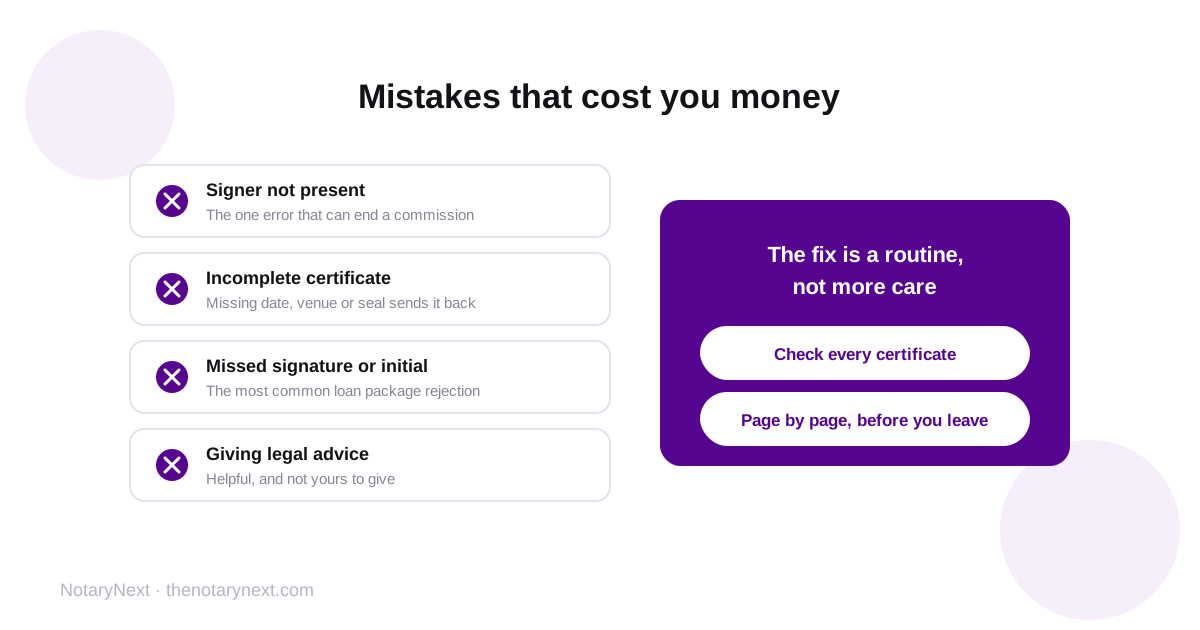
This is the cardinal error. The signer must personally appear before you at the time of the notarization. Not their spouse with the document. Not a signature they added this morning before you arrived. Not over the phone.
Notarizing for someone who is not physically present, where remote online notarization is not authorized and properly performed, is a serious violation that can end a commission and create real legal exposure. There is no version of this that is worth the fee.
Instead: if the signer cannot be present, reschedule. Every time, without exception.
2. Accepting improper identification
Expired identification. A photocopy. A document without a photograph. An ID you cannot verify because your state's rules say otherwise.
Identification is the core of your role. If you cannot properly identify the signer under your state's rules, you cannot proceed.
Instead: know exactly what forms of identification your state accepts and what to do when a signer lacks one, including whether credible witnesses are permitted where you work.
3. Leaving the notarial certificate incomplete
Missing the date. Missing the venue, meaning the state and county. Missing your commission expiration. An unsigned certificate.
Incomplete certificates are one of the most common reasons loan packages get rejected and sent back, and the fix costs you a second trip.
Instead: before you leave any signing, check every notarial certificate for date, venue, signature, and seal. Build it into your routine as a final step, every time.
4. Notarizing a document with blank spaces
A document with blanks can be completed after you notarize it, and the completed version carries your seal as though you witnessed it. That is exactly the kind of fraud your role exists to deter.
Instead: ask the signer to complete or strike through blanks before you notarize.
5. Using an expired commission or seal
Commissions expire. Notaries get busy and miss the renewal window. Every notarization performed after expiration is invalid.
Instead: calendar your renewal well in advance, and check your seal's expiration date against your commission.
6. Giving legal advice
A signer asks what a document means, whether they should sign, or which option to choose. Answering feels helpful. It is also, in most cases, the unauthorized practice of law.
Instead: explain that you cannot advise on the content and refer them to the party who prepared the document, their attorney, or the lender. You can identify what a document is. You cannot interpret it or recommend a course of action.
7. Notarizing for family or where you have an interest
Many states restrict or prohibit notarizing for immediate family or for transactions in which you have a financial interest. Even where technically permitted, it undermines the impartiality your role depends on.
Instead: refer it to another notary. The fee is not worth the appearance of a conflict.
8. Failing to keep a journal
Covered in depth in our notary journal guide, but it belongs on this list. The notary with no record has no defense if a notarization is challenged years later.
Instead: keep a complete, contemporaneous journal whether or not your state requires one.
9. Missing signatures and initials in a loan package
For signing agents, this is the most frequent and most costly error. A loan package has dozens of signature lines, initial boxes, and dates. One missed line means a rejected package, a rushed fix, and a title agency that noticed.
Instead: develop a consistent page by page review before you leave the table. Check every signature line, every initial box, and every date field. Then check again. The five minutes you spend costs far less than the return trip.
10. Wrong dates on loan documents
Loan packages often include documents that must be dated specifically, and borrowers instinctively write today's date on everything. Wrong dates on the wrong documents can affect the transaction.
Instead: know which documents in a package require which dates, and guide borrowers as you go rather than correcting after.
11. Sloppy communication with the hiring party
Not confirming receipt of an assignment. Going quiet when a signing runs into trouble. Failing to report a problem until the title agency discovers it themselves.
Signing agents are rarely dropped for a single document error. They are dropped for being hard to reach when something goes wrong.
Instead: confirm assignments promptly, report problems immediately, and send scanbacks fast. Being easy to work with is a competitive advantage most notaries underestimate.
12. Treating the business side casually
Not invoicing. Invoicing late. Losing track of who has paid. Never following up on an invoice that went unpaid ninety days ago. Never asking anyone for a review.
None of these are notarial errors, and all of them cost real money. The notary who performs flawlessly and forgets to invoice three signings a month is losing more than the one who occasionally misses an initial box.
Instead: put the business side on a system rather than your memory. That is exactly what we built NotaryNext for. We generate and send the invoice the moment you mark a signing complete, chase late title agencies at 30, 45, and 60 days, track every client and what they are worth to you, and ask every signer for a Google review automatically. You handle the notarizations. We handle everything around them, free for 30 days.
What to do when you catch a mistake after the fact
It happens to everyone eventually. You are home, reviewing, and you realize a certificate is missing a date or a page was not initialed.
Act immediately rather than hoping nobody notices. Contact the hiring party or title agency right away, explain plainly what you found, and offer to correct it. A notary who self reports a problem and fixes it same day is far more trusted than one whose error is discovered downstream.
What you must not do is alter a document after the fact without the signer present, or backdate anything to make a record look cleaner than it was. A correction handled properly is a small problem. A correction handled improperly is a serious one.
The pattern behind most of these
Look at the list and a theme emerges. Almost every expensive mistake comes from either rushing at the end of a signing or relying on memory instead of a routine.
The fix for both is the same: build fixed habits. A final certificate check before you stand up. A page by page review before you leave. A journal entry at the time, not later. A system that invoices without you remembering to.
Experienced notaries are not more careful by nature. They have simply turned the things that used to cost them money into habits they no longer have to think about.
This article is general information, not legal advice. Notary rules vary by state. Confirm your state's requirements with your commissioning authority.
Related: Notary journal requirements · What does a notary do? · How to become a loan signing agent


