How to Become a Notary Public in 2026 (Complete State-by-State Guide)
Everything you need to become a notary public — the requirements, steps, costs, and timeline — plus how to turn your commission into an actual income once you have it.
Introduction
Becoming a notary public is one of the most accessible ways to start a flexible business or side income — the barrier to entry is low, the startup cost is modest, and you can often be commissioned within a few weeks. But the process varies by state, and the part nobody explains is what to do after you get commissioned to actually earn from it. This guide covers both.
What a notary public actually does
A notary public is a state-appointed official who serves as an impartial witness to the signing of important documents. Your job is to verify the identity of signers, confirm they're signing willingly and knowingly, and deter fraud. You'll notarize things like affidavits, acknowledgments, powers of attorney, deeds, and — if you go further into loan signing — mortgage and refinance packages.
Notaries don't give legal advice, prepare documents, or decide whether a document is valid. You're the trusted witness, not the lawyer. Understanding that boundary is one of the first things you'll learn, and it protects you throughout your career.
The general steps to become a notary
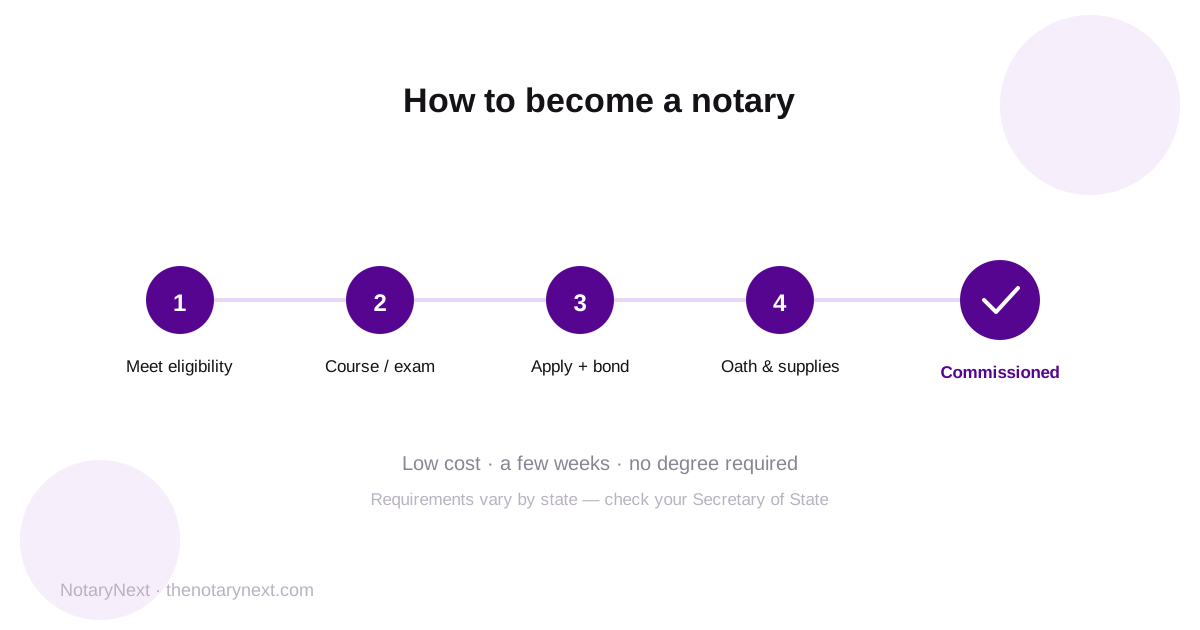
While the details differ by state, the path almost always follows these steps:
1. Confirm you meet the basic eligibility requirements. Most states require that you:
Are at least 18 years old
Are a legal resident of (or employed in) the state where you're applying
Can read and write English
Have no disqualifying criminal history
2. Complete a required course or training (where applicable). Some states require an approved notary education course before you can apply; others don't require any training at all. Even where it's optional, a short course is worth it — it teaches you how to actually perform notarizations correctly and avoid the mistakes that create liability.
3. Pass an exam (in some states). A handful of states require you to pass a notary exam. Where required, it's usually straightforward if you've taken the course.
4. Complete your application and pay the state fee. You'll submit an application to your state's commissioning authority — usually the Secretary of State — along with the required fee. Fees vary but are generally modest.
5. Get a surety bond (in most states). Many states require notaries to purchase a surety bond, which protects the public from financial harm caused by notary errors. This is not insurance for you — it protects others — which is why many notaries also buy separate E&O insurance (more below).
6. Take your oath of office. Once approved, you may need to file your oath and commission with a county office, depending on your state.
7. Buy your supplies. At minimum, your official stamp/seal and a notary journal to record your acts.
How long it takes and what it costs
Timeline: In many states, the whole process takes a few weeks — largely waiting on application processing. States with education and exam requirements (like California) take longer; states with minimal requirements can be quick.
Cost: Between the application fee, bond, course (if required), stamp, and journal, most new notaries spend somewhere in the low hundreds of dollars to get commissioned. It's one of the least expensive professional credentials you can earn.
Always check your specific state's Secretary of State website for exact requirements, fees, and timelines — these genuinely differ, and your state's authority is the definitive source.
After you're commissioned: making it an income
Here's the part most guides skip. A commission by itself doesn't earn anything — what you do with it determines whether it's a certificate in a drawer or a real income. Your main paths:
General notary work (GNW). Notarizing individual documents for the public — often as a mobile notary who travels to clients. You charge your state's allowed notarial fee per act, plus a travel fee. Great for flexible, local, supplemental income.
Loan signing agent work. The higher-earning path: specializing in guiding borrowers through mortgage and refinance signings, priced per signing (commonly $75–$200). This requires additional loan-signing training and usually a background check, but it's where most serious notary income comes from. (Full guide: how to become a loan signing agent.)
Remote online notarization (RON). Notarizing over live video for signers anywhere, where your state authorizes it. (What RON is and how it works.)
Many notaries combine these — GNW for local walk-up work, loan signings for volume, RON for reach.
Protecting yourself: E&O insurance
Separate from your required bond, errors & omissions (E&O) insurance protects you financially if a notarization mistake leads to a claim. It's optional in most states but strongly recommended, and signing services often expect it. Policies are inexpensive relative to the protection they provide.
Setting up your notary business the right way
Once you're commissioned and taking work, you're running a business — and the notaries who succeed treat it like one from day one. That means: invoicing clients professionally and promptly, following up on unpaid invoices (especially with title companies, who pay on 30–60 day terms), collecting reviews to get found by future clients, and keeping clean records for tax time.
Doing all of that manually is exactly where new notaries lose money and time. NotaryNext handles the business side automatically: invoices that generate and send the moment you complete a job, overdue payment reminders that chase slow payers for you, automatic review requests after every signing, and all your clients and jobs organized in one place. It's built specifically for mobile notaries and signing agents — so from your very first signing, the business runs like you've been doing it for years. Start free for 30 days, no credit card required.
The bottom line
Becoming a notary is genuinely accessible: modest cost, a few weeks, no degree required. The commission is the easy part. Turning it into steady income comes from choosing your path (GNW, loan signings, RON, or a mix), getting the right training and protection, and running the business side like a professional from the start. Do that, and a low-cost credential becomes a flexible, durable income.
Related: How to become a loan signing agent · How much do notaries make? · Mobile notary supplies checklist


